
Call us
301-363-4651 (Available 9 a.m. to 5 p.m. CST from Monday to Friday)

| Code | CSB-RA981267A0HU |
| Size | US$210 |
| Order now | |
| Image |
|
| Have Questions? | Leave a Message or Start an on-line Chat |
| Application | Recommended Dilution |
|---|---|
| WB | 1:500-1:5000 |
| IHC | 1:50-1:200 |
GRB2 serves as a critical adaptor protein in receptor tyrosine kinase signaling, bridging activated growth factor receptors to downstream Ras-MAPK pathway components through its characteristic SH2 and SH3 domains. This positioning makes GRB2 a key node in understanding how cells translate extracellular growth signals into proliferative responses, with particular relevance to cancer biology where aberrant signaling through this pathway frequently drives tumor progression.
This recombinant monoclonal antibody, generated against a synthetic peptide derived from human GRB2, offers the reproducibility and sequence-defined consistency that demanding experimental workflows require. Because the antibody sequence is fixed at the genetic level, researchers can expect uniform performance across experiments and over time, eliminating the lot-to-lot variability that can complicate long-term studies or multi-site collaborations.
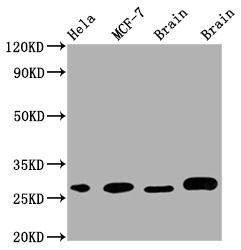
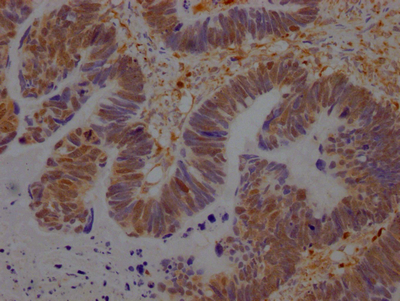
Validation studies demonstrate robust performance across multiple applications and species. In western blot analysis, the antibody detects GRB2 in HeLa and MCF-7 human cell lysates as well as mouse and rat brain tissue, confirming cross-species reactivity that expands experimental flexibility for comparative studies or work with rodent models. The observed band at approximately 28 kDa runs slightly higher than the predicted molecular weight of 21-26 kDa, a shift commonly attributable to post-translational modifications such as phosphorylation or ubiquitination. For tissue-based studies, immunohistochemistry validation in paraffin-embedded human ovarian cancer tissue demonstrates clear target detection, supporting investigations into GRB2 expression patterns in clinical specimens.
Whether investigating receptor tyrosine kinase signaling mechanisms or exploring GRB2's role in oncogenic transformation, this antibody provides a reliable tool for signal transduction and cancer research applications.
There are currently no reviews for this product.





