
Call us
301-363-4651 (Available 9 a.m. to 5 p.m. CST from Monday to Friday)

| Code | CSB-RA005061A15phHU |
| Size | US$210 |
| Order now | |
| Image |
|
| Have Questions? | Leave a Message or Start an on-line Chat |
| Application | Recommended Dilution |
|---|---|
| WB | 1:500-1:5000 |
| IHC | 1:50-1:200 |
| IP | 1:200-1:1000 |
Cyclin-dependent kinase 2 plays a central role in cell cycle progression, particularly during the G1/S transition and S phase entry. Phosphorylation at tyrosine 15 serves as a critical inhibitory modification that keeps CDK2 in an inactive state until the cell is ready to commit to DNA replication. Detecting this specific phosphorylation event allows researchers to monitor cell cycle checkpoint regulation, study the mechanisms controlling proliferation, and investigate how these pathways become dysregulated in disease states.
This recombinant monoclonal antibody, generated against a synthetic phosphopeptide corresponding to the Y15 site of human CDK2, offers the reproducibility and consistency that phospho-specific detection demands. Because the antibody sequence is defined and production occurs in a controlled recombinant system, researchers can expect uniform performance across experiments and over time, eliminating the lot-to-lot variability that can complicate longitudinal studies of signaling dynamics.
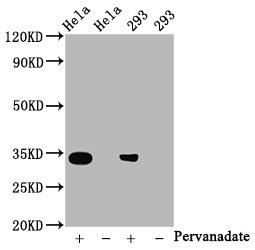
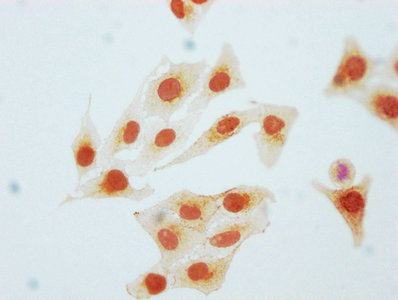
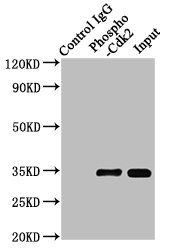
Validation data demonstrates reliable performance across multiple experimental platforms. Western blot analysis detects a band at the predicted 34 kDa molecular weight in both HeLa and 293 cell lysates, with pervanadate treatment enhancing signal detection as expected for a phospho-specific antibody. Immunocytochemistry staining in pervanadate-treated HeLa cells confirms utility for visualizing subcellular localization of the phosphorylated kinase. Immunoprecipitation experiments successfully enrich phospho-CDK2 from HeLa lysates, enabling downstream analysis of protein complexes or post-translational modifications.
This antibody supports cell biology research focused on cell cycle control, checkpoint signaling, and proliferation mechanisms. The combination of phospho-specificity, recombinant consistency, and multi-application validation makes it a practical choice for investigators studying CDK2 regulation in human cell models.
There are currently no reviews for this product.





