
Call us
301-363-4651 (Available 9 a.m. to 5 p.m. CST from Monday to Friday)

| Code | CSB-RA011972A63phHU |
| Size | US$210 |
| Order now | |
| Image |
|
| Have Questions? | Leave a Message or Start an on-line Chat |
| Application | Recommended Dilution |
|---|---|
| WB | 1:500-1:5000 |
| IHC | 1:50-1:200 |
| IF | 1:20-1:200 |
JUN, also known as c-Jun or AP-1, serves as a critical transcription factor that orchestrates cellular responses to growth factors, stress signals, and oncogenic stimuli. Phosphorylation at serine 63 represents a key activation event that enhances JUN's transcriptional activity, making this modification an essential readout for researchers studying MAPK signaling cascades, cellular transformation, and stress-induced gene expression programs.
This recombinant monoclonal antibody, generated against a synthetic phosphopeptide encompassing the S63 site of human JUN, offers the reproducibility and sequence-defined specificity that phospho-specific detection demands. Because recombinant production eliminates the batch variability inherent to traditional hybridoma methods, researchers can confidently compare phosphorylation dynamics across experiments spanning months or years of investigation.
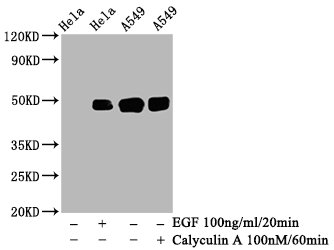
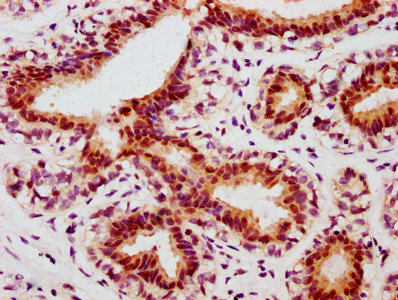
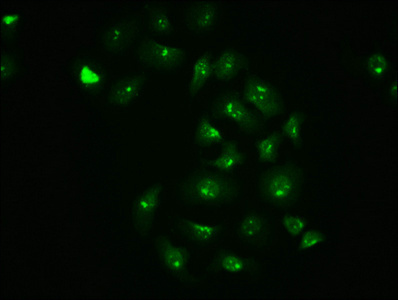
Validation studies demonstrate robust performance across multiple experimental platforms. Western blot analysis detects the expected 48 kDa band in HeLa whole cell lysates and in A549 cells stimulated with either Calyculin A or EGF, confirming the antibody's ability to track phospho-JUN induction under different activation conditions. Immunohistochemistry staining in paraffin-embedded human breast cancer tissue reveals clear signal using citrate-based antigen retrieval, while immunofluorescence in A549 cells shows appropriate nuclear localization consistent with JUN's function as a transcription factor.
The antibody's compatibility with ELISA, western blotting, immunohistochemistry, and immunofluorescence provides flexibility for researchers examining JUN phosphorylation from biochemical quantification through spatial localization in tissues and cells. For investigators exploring epigenetics, nuclear signaling, or the oncogenic pathways where JUN phosphorylation drives proliferative and survival programs, this antibody delivers the specificity and consistency that mechanistic studies require.
There are currently no reviews for this product.





