
Call us
301-363-4651 (Available 9 a.m. to 5 p.m. CST from Monday to Friday)

| Code | CSB-RA182616A0HU |
| Size | US$210 |
| Order now | |
| Image |
|
| Have Questions? | Leave a Message or Start an on-line Chat |
| Application | Recommended Dilution |
|---|---|
| WB | 1:500-1:5000 |
| IHC | 1:50-1:200 |
Caspase-3 stands as a central executioner in the apoptotic cascade, serving as the convergence point for both intrinsic and extrinsic cell death pathways. This cysteine protease cleaves numerous cellular substrates during programmed cell death, making it an indispensable marker for researchers investigating apoptosis mechanisms, cancer biology, and therapeutic responses. Understanding caspase-3 activation and expression patterns provides critical insights into how cells commit to death and how this process becomes dysregulated in disease states.
This recombinant monoclonal antibody, generated against a synthetic peptide derived from human caspase-3, offers the reproducibility that demanding experimental workflows require. Because the antibody sequence is defined and production occurs in a controlled recombinant system, you can expect consistent performance across different lots, eliminating the variability that can complicate longitudinal studies or multi-site collaborations.
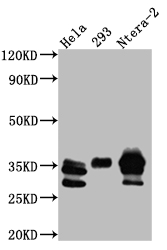
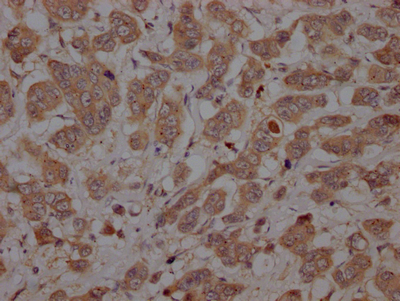
Validation testing demonstrates reliable detection across multiple human cell lines in western blot applications, including HeLa, HEK293, and Ntera-2 whole cell lysates. At the recommended dilution range of 1:500 to 1:5000, the antibody detects bands at both 32 kDa and 28 kDa. The 32 kDa band corresponds to the predicted full-length procaspase-3, while the smaller band likely represents either a processed form or post-translational modification variant commonly observed with this protein. For immunohistochemistry, testing in paraffin-embedded human breast cancer tissue at 1:100 dilution confirms suitability for examining caspase-3 expression in fixed tissue sections, with standard citrate buffer antigen retrieval providing effective epitope exposure.
Whether you are characterizing apoptotic responses in cancer models, studying metabolic stress-induced cell death, or screening therapeutic compounds, this antibody provides a dependable tool for your caspase-3 detection needs.
There are currently no reviews for this product.





