
Call us
301-363-4651 (Available 9 a.m. to 5 p.m. CST from Monday to Friday)

| Code | CSB-RA024077A33phHU |
| Size | US$210 |
| Order now | |
| Image |
|
| Have Questions? | Leave a Message or Start an on-line Chat |
| Application | Recommended Dilution |
|---|---|
| IHC | 1:50-1:200 |
| IF | 1:20-1:200 |
Phosphorylation of tumor suppressor p53 at serine 33 represents a critical regulatory event in the cellular DNA damage response pathway. This site-specific modification, mediated by kinases including p38 MAPK and CDK7, stabilizes p53 and enhances its transcriptional activity, ultimately influencing cell cycle arrest and apoptotic decisions. Detecting this phosphorylation event with precision is essential for researchers investigating stress signaling, checkpoint control, and the mechanisms underlying cancer development and therapeutic resistance.
This recombinant monoclonal antibody, generated against a synthetic phosphopeptide corresponding to human Phospho-TP53 at serine 33, offers the reproducibility and consistency that demanding experimental workflows require. As a sequence-defined recombinant clone, it eliminates the lot-to-lot variability inherent in traditional hybridoma-derived antibodies, ensuring that your results remain comparable across extended studies and collaborative projects. The rabbit IgG format provides excellent signal-to-noise characteristics for immunodetection applications.
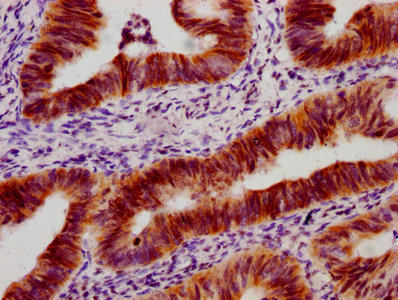
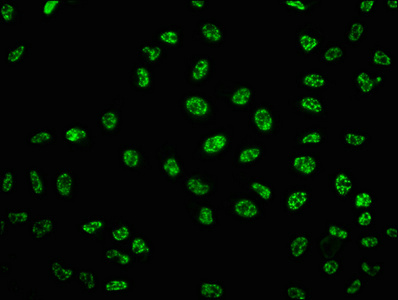
Validation studies demonstrate reliable performance across multiple experimental platforms. In immunohistochemistry, the antibody produces clear staining in paraffin-embedded human colon cancer tissue at dilutions of 1:50 to 1:200, with validated protocols using citrate buffer antigen retrieval. Immunofluorescence applications show distinct nuclear localization in HeLa cells, consistent with the expected subcellular distribution of activated p53, with recommended working dilutions of 1:20 to 1:200. The antibody is also suitable for ELISA-based detection methods.
For researchers exploring p53 signaling dynamics in cancer biology, DNA damage responses, or checkpoint regulation, this phospho-specific antibody provides a dependable tool for monitoring this functionally significant post-translational modification in human samples.
There are currently no reviews for this product.





