
Call us
301-363-4651 (Available 9 a.m. to 5 p.m. CST from Monday to Friday)

| Code | CSB-AP005161HU |
| Abbreviation | Recombinant Human CD86 protein, partial (Active) |
| MSDS | |
| Size | $96 |
| Order now | |
| Image |
|
| Have Questions? | Leave a Message or Start an on-line Chat |
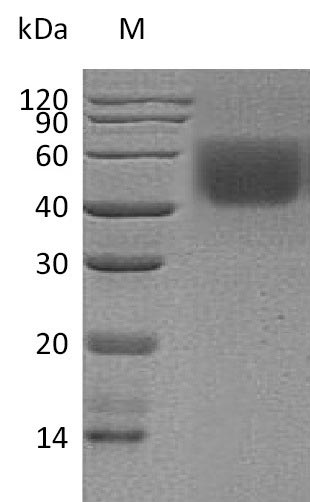
CD86 serves as a critical costimulatory ligand in immune checkpoint signaling, engaging both CD28 and CTLA-4 to regulate T-cell activation and tolerance. This recombinant human CD86 extracellular domain (aa 24–247) demonstrates confirmed binding to CTLA-4-Fc with an ED50 of 1.19 μg/ml in functional ELISA, providing a suitable basis for receptor-ligand interaction assays, competitive inhibition studies, and blocking antibody screening in checkpoint immunology research. Mammalian cell expression preserves native glycosylation and conformational integrity of the IgV and IgC domains, which supports reliable performance in SPR- or BLI-based affinity characterization, therapeutic antibody epitope mapping, and small-molecule inhibitor screening targeting the CTLA-4/CD86 axis. Purity exceeding 95% by SDS-PAGE combined with endotoxin levels below 1.0 EU/μg satisfies the criteria typical for cell-based costimulation assays and as a positive control in binding experiments.
Applications : As control proteins
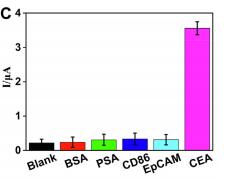
Review: To verify the specificity of the sensor for CEA detection, control experiments were carried out by using BSA, PSA, CD86 and EpCAM as control proteins. As shown in Fig. 4C, an obvious current was obtained in buffer containing CEA while only negligible currents were obtained in control groups containing BSA, PSA, CD86 and EpCAM even at a 10-fold concentration of CEA, indicating the specificity of the sensor.
By Anonymous





