
Call us
301-363-4651 (Available 9 a.m. to 5 p.m. CST from Monday to Friday)

| Code | CSB-RA441361A0HU |
| Size | US$210 |
| Order now | |
| Image |
|
| Have Questions? | Leave a Message or Start an on-line Chat |
| Application | Recommended Dilution |
|---|---|
| IF | 1:50-1:200 |
| FC | 1:50-1:200 |
MAPK9, also known as JNK2 (c-Jun N-terminal kinase 2), serves as a critical mediator of cellular stress responses and apoptotic signaling pathways. As a member of the stress-activated protein kinase family, MAPK9 phosphorylates key transcription factors including c-Jun, playing essential roles in inflammation, neurodegeneration, and cancer biology. Understanding MAPK9 activation and localization provides valuable insights into how cells respond to environmental stressors, cytokines, and growth factor withdrawal.
This recombinant monoclonal antibody, clone 3F10, offers the reproducibility and consistency that demanding research applications require. Generated against a synthetic peptide derived from human MAPK9 and produced using recombinant technology in rabbit host, this antibody delivers sequence-defined specificity with minimal lot-to-lot variation. The affinity-chromatography purification ensures high purity, while the unconjugated format provides flexibility for pairing with your preferred secondary detection systems.
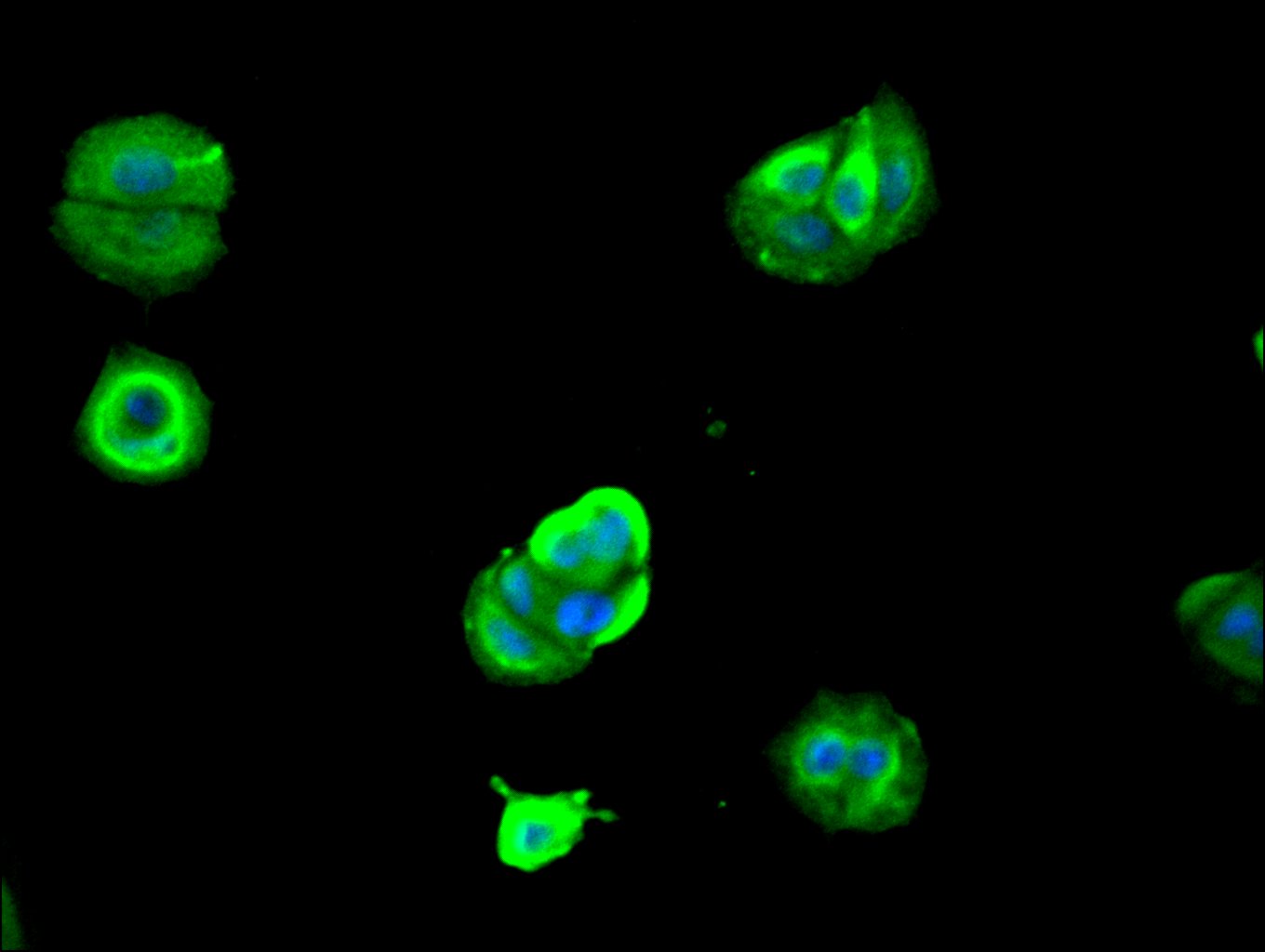
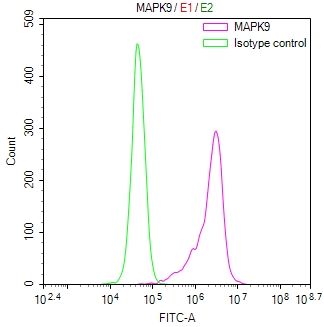
Validation studies demonstrate reliable performance in both immunofluorescence and flow cytometry applications using human samples. Immunofluorescence staining of MCF-7 breast cancer cells reveals clear MAPK9 detection when used at dilutions between 1:50 and 1:200, with the signal distinctly visualized against DAPI nuclear counterstaining. Flow cytometry analysis of the same cell line confirms specific detection, with overlay histograms showing clear separation between antibody-stained populations and isotype control samples at 1:100 dilution.
This antibody supports researchers investigating stress-activated kinase signaling, apoptosis regulation, and inflammatory responses. Its validated performance in cell-based assays makes it particularly suitable for studies examining MAPK9 expression patterns, subcellular localization, and population-level protein expression analysis in human cell models.
There are currently no reviews for this product.





