
Call us
301-363-4651 (Available 9 a.m. to 5 p.m. CST from Monday to Friday)

| Code | CSB-RA074719A0HU |
| Size | US$210 |
| Order now | |
| Image |
|
| Have Questions? | Leave a Message or Start an on-line Chat |
| Application | Recommended Dilution |
|---|---|
| FC | 1:50-1:200 |
Protein kinase C beta (PRKCB) serves as a critical signaling hub in cellular processes ranging from B cell activation and immune responses to neuronal function and metabolic regulation. As a calcium-dependent serine/threonine kinase, PRKCB transduces signals from numerous receptor pathways, making it a compelling target for researchers investigating signal transduction, autoimmunity, diabetes complications, and certain malignancies where aberrant PKC signaling contributes to disease progression.
This recombinant monoclonal antibody, clone 14E3, offers the reproducibility that demanding experimental workflows require. Generated through recombinant technology with a defined sequence, it eliminates the lot-to-lot variability that can compromise longitudinal studies or multi-site collaborations. The rabbit host and monoclonal nature ensure high specificity for human PRKCB, with the antibody raised against a synthetic peptide immunogen and purified by affinity chromatography for optimal performance.
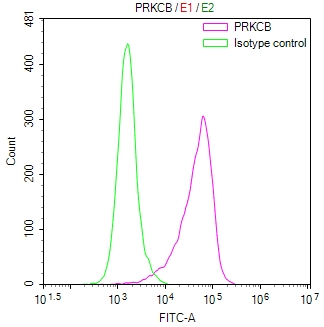
Validation by flow cytometry demonstrates reliable intracellular detection of PRKCB in K562 cells, a human erythroleukemia line commonly used in signal transduction research. The clear separation between specific staining and isotype control confirms robust target recognition, with recommended dilutions of 1:50 to 1:200 providing flexibility to optimize signal-to-background ratios for your specific experimental conditions. The antibody is also validated for ELISA applications, supporting quantitative detection approaches.
Supplied in a glycerol-containing buffer optimized for long-term stability at -20°C or -80°C, this unconjugated format allows pairing with your preferred secondary detection system. Whether investigating PKC-mediated signaling cascades, characterizing immune cell populations, or exploring PRKCB's role in disease models, this antibody provides the consistency essential for meaningful experimental outcomes.
There are currently no reviews for this product.





