
Call us
301-363-4651 (Available 9 a.m. to 5 p.m. CST from Monday to Friday)

| Code | CSB-RA267127A0HU |
| Size | US$210 |
| Order now | |
| Image |
|
| Have Questions? | Leave a Message or Start an on-line Chat |
| Application | Recommended Dilution |
|---|---|
| IF | 1:20-1:200 |
Janus kinase 2 (JAK2) serves as a critical non-receptor tyrosine kinase that transduces cytokine-mediated signals, playing essential roles in hematopoiesis, immune function, and cell growth regulation. As a central component of the JAK-STAT signaling pathway, JAK2 has become a focal point in cancer research, particularly in myeloproliferative neoplasms where activating mutations drive disease progression. Understanding JAK2 expression, localization, and signaling dynamics remains fundamental to advancing therapeutic strategies targeting this pathway.
This recombinant monoclonal antibody, clone 10B6, offers researchers the reproducibility advantages inherent to recombinant technology. Because the antibody sequence is defined and produced from a stable expression system, you can expect consistent performance across experiments and over time, eliminating the lot-to-lot variability that can complicate long-term studies or multi-site collaborations. The rabbit IgG format, raised against a synthetic peptide derived from human JAK2, provides high specificity for detecting this kinase in human samples.
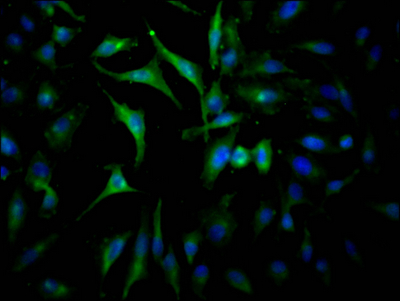
Validation through immunofluorescence demonstrates clear utility for subcellular localization studies. Testing in HeLa cells at 1:50 dilution revealed specific staining patterns when cells were fixed with formaldehyde and permeabilized with Triton X-100, providing a reliable starting point for optimizing your own imaging protocols. The recommended working range of 1:20 to 1:200 for immunofluorescence applications gives flexibility to adjust signal intensity based on your experimental system and detection setup.
This antibody supports investigations across epigenetics, nuclear signaling, cancer biology, and signal transduction research, making it a versatile tool for laboratories studying JAK-STAT pathway regulation and its implications in disease.
There are currently no reviews for this product.





