
Call us
301-363-4651 (Available 9 a.m. to 5 p.m. CST from Monday to Friday)

| Code | CSB-RA957619A0HU |
| Size | US$210 |
| Order now | |
| Image |
|
| Have Questions? | Leave a Message or Start an on-line Chat |
| Application | Recommended Dilution |
|---|---|
| WB | 1:500-1:5000 |
| IHC | 1:50-1:200 |
| IP | 1:200-1:1000 |
MAP2K1, also known as MEK1, serves as a critical dual-specificity kinase in the RAS-RAF-MEK-ERK signaling cascade, one of the most extensively studied pathways in cell biology. As the direct activator of ERK1/2, MAP2K1 plays an essential role in transmitting extracellular signals that regulate cell proliferation, differentiation, and survival. Dysregulation of this pathway is implicated in numerous cancers and developmental disorders, making MAP2K1 a key target for researchers investigating signal transduction mechanisms and therapeutic interventions.
This recombinant monoclonal antibody, raised in rabbit against a synthetic peptide derived from human MEK1, offers the reproducibility and consistency that demanding experimental workflows require. Because the antibody sequence is defined and produced recombinantly, researchers can expect uniform performance across lots, eliminating the variability often encountered with traditional hybridoma-derived antibodies.
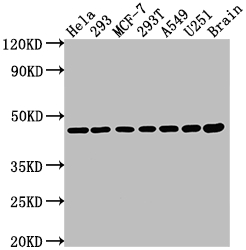
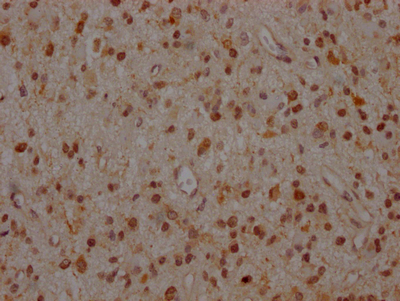
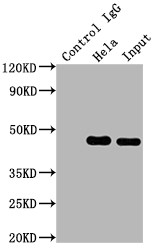
Validation studies demonstrate robust performance across multiple applications. In western blotting, the antibody detects a clear band at the expected 44 kDa molecular weight across a diverse panel of human cell lines including HeLa, HEK293, MCF-7, 293T, A549, and U251, as well as rat brain tissue, confirming cross-species reactivity between human and rat samples. Immunohistochemistry validation in paraffin-embedded human glioma tissue shows specific staining, while immunoprecipitation experiments successfully pull down MAP2K1 from HeLa whole cell lysates, demonstrating utility for protein interaction studies.
The flexibility to work across ELISA, western blotting, immunohistochemistry, and immunoprecipitation makes this antibody a versatile tool for researchers studying MAPK signaling, cancer biology, and cellular response mechanisms.
There are currently no reviews for this product.





