
Call us
301-363-4651 (Available 9 a.m. to 5 p.m. CST from Monday to Friday)

| Code | CSB-RA021081MA1HU |
| Size | $49.9 |
| Order now | |
| Promotion |

|
| Image |
|
| Have Questions? | Leave a Message or Start an on-line Chat |
| Application | Recommended Dilution |
|---|---|
| WB | 1:500-1:2000 |
| FC | 1:50-1:200 |
SERPINE1, commonly known as plasminogen activator inhibitor-1 (PAI-1), serves as a critical regulator of the fibrinolytic system by inhibiting tissue-type and urokinase-type plasminogen activators. Beyond its well-established role in hemostasis and thrombosis, SERPINE1 has emerged as a significant player in tumor progression, cellular senescence, and fibrotic disease, making it a compelling target for researchers investigating cardiovascular pathology, cancer biology, and aging-related processes.
This recombinant monoclonal antibody, clone 9H8, offers the reproducibility and consistency that demanding experimental workflows require. Because it is generated through recombinant expression rather than traditional hybridoma methods, each lot delivers sequence-defined performance, eliminating the variability that can compromise longitudinal studies or multi-site collaborations. The human IgG1 isotype format provides predictable behavior across detection systems while the affinity-chromatography purification ensures high specificity for your target.
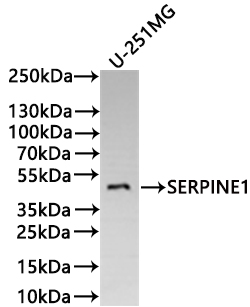
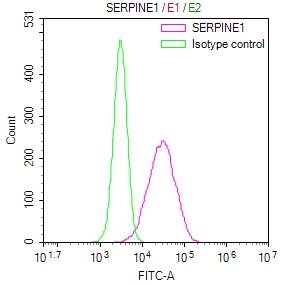
Validation studies confirm reliable performance across multiple platforms. In Western blot applications, this antibody detects SERPINE1 at the expected 45 kDa molecular weight in U-251MG glioblastoma cell lysates, with recommended dilutions ranging from 1:500 to 1:2000. Flow cytometry validation using 786-O renal carcinoma cells demonstrates clear positive signal separation from isotype controls at dilutions between 1:50 and 1:200, supporting intracellular detection protocols following fixation and permeabilization. The antibody is also validated for ELISA applications, providing flexibility for quantitative studies.
Whether you are investigating PAI-1's contribution to tumor microenvironment remodeling, exploring its role in senescence-associated secretory phenotypes, or studying thrombotic mechanisms, this recombinant antibody delivers the technical confidence needed for meaningful experimental outcomes in human sample analysis.
There are currently no reviews for this product.





