
Call us
301-363-4651 (Available 9 a.m. to 5 p.m. CST from Monday to Friday)

| Code | CSB-E04627m-IS |
| Size | 96T,5×96T,10×96T |
| Price | Request a Quote |
| Trial Size |
24T ELISA Kit Trial Size (Only USD$150/ kit) * Sample kit cost can be deducted as a $30 credit for each 96-assay kit of the same analyte and brand you subsequently purchase within six months until depleted. More details >> Interested in a trial size? Please leave a message below.
|
| Have Questions? | Leave a Message or Start an on-line Chat |
Intra-assay Precision (Precision within an assay): CV%<8% | ||||||
Three samples of known concentration were tested twenty times on one plate to assess. | ||||||
Inter-assay Precision (Precision between assays): CV%<10% | ||||||
Three samples of known concentration were tested in twenty assays to assess. | ||||||
To assess the linearity of the assay, samples were spiked with high concentrations of mouse IL-2 in various matrices and diluted with the Sample Diluent to produce samples with values within the dynamic range of the assay. | ||||||
| Sample | Serum(n=4) | ||||
1:1 | Average % | 89 | ||||
Range % | 84-95 | |||||
1:2 | Average % | 92 | ||||
Range % | 85-99 | |||||
1:4 | Average % | 98 | ||||
Range % | 91-105 | |||||
1:8 | Average % | 93 | ||||
Range % | 86-98 | |||||
The recovery of mouse IL-2 spiked to levels throughout the range of the assay in various matrices was evaluated. Samples were diluted prior to assay as directed in the Sample Preparation section. | ||||||
Sample Type | Average % Recovery | Range | ||||
Serum (n=5) | 94 | 87-101 | ||||
EDTA plasma (n=4) | 88 | 81-95 | ||||
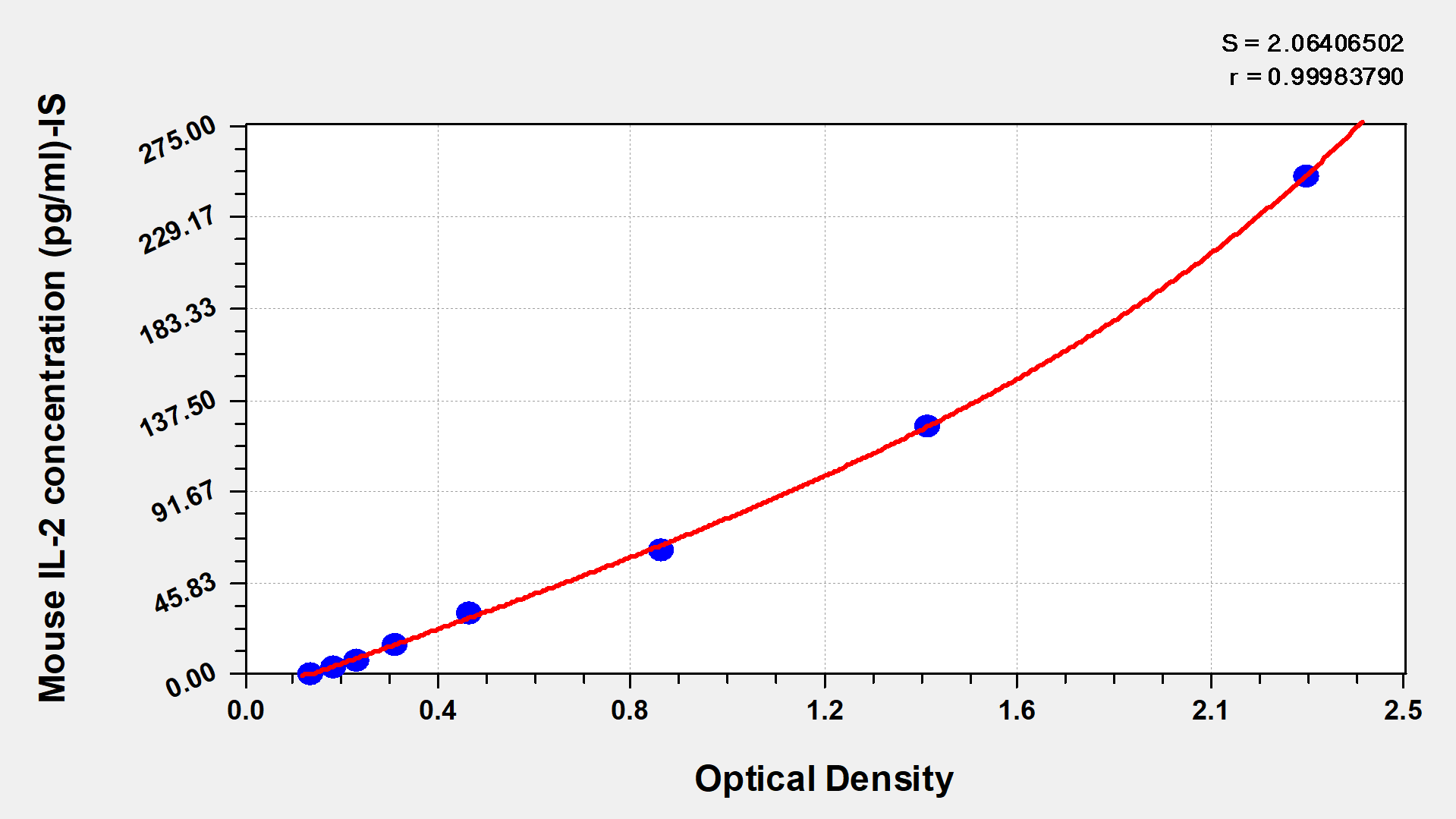
These standard curves are provided for demonstration only. A standard curve should be generated for each set of samples assayed. | |||||||
| |||||||
pg/ml | OD1 | OD2 | Average | Corrected | |||
250 | 2.278 | 2.234 | 2.256 | 2.104 | |||
125 | 1.443 | 1.467 | 1.455 | 1.303 | |||
62.5 | 0.904 | 0.888 | 0.896 | 0.744 | |||
31.25 | 0.473 | 0.499 | 0.486 | 0.334 | |||
15.6 | 0.341 | 0.321 | 0.331 | 0.179 | |||
7.8 | 0.245 | 0.253 | 0.249 | 0.097 | |||
3.9 | 0.208 | 0.198 | 0.203 | 0.051 | |||
0 | 0.149 | 0.155 | 0.152 |
| |||
This kit provides quantitative measurement of interleukin-2 (IL-2) in mouse samples, supporting research into T cell activation, proliferation, and immune regulation. Because IL-2 is produced transiently and at low concentrations following T cell receptor engagement, detecting it requires an assay calibrated for the picogram-level abundances typical of both *in vivo* and *in vitro* immunological models.
Detection Range: The 3.9–250 pg/ml range spans the concentrations expected in mouse serum during acute immune responses and in supernatants from antigen- or mitogen-stimulated splenocyte cultures. Most resting or mildly stimulated samples fall within range without dilution, while strongly activated cultures may require a simple pre-dilution step.
Sensitivity: At 0.975 pg/ml, the assay detects IL-2 in conditions where secretion is minimal — such as early time points post-stimulation, regulatory T cell co-cultures that suppress IL-2 production, or serum from naïve mice — where concentrations often sit in the low single-digit pg/ml range.
Sample Compatibility: Validation across serum, plasma, tissue homogenates, and cell culture supernatants allows researchers to correlate systemic IL-2 levels with local tissue microenvironment concentrations and *in vitro* functional readouts within a single experimental framework.
Assay Efficiency: A 50–100 µl sample requirement accommodates the limited volumes obtainable from mouse orbital bleeds or primary T cell cultures, while the 1–5 hour protocol fits within same-day workflows alongside proliferation or cytotoxicity assays.
This kit is well suited for studies of graft-versus-host disease, checkpoint immunotherapy response, and Treg-mediated immune suppression in mouse models.
There are currently no reviews for this product.





