Call us
301-363-4651 (Available 9 a.m. to 5 p.m. CST from Monday to Friday)

PCK2, full name phosphoenolpyruvate carboxykinase 2, also known as mitochondrial PEPCK. It is a key metabolic enzyme in gluconeogenesis, maintaining blood glucose homeostasis and providing energy for the body. Abnormal PCK2 overexpression promotes gluconeogenesis and correlates with diabetes, and drives tumor metabolic reprogramming in multiple cancers. PCK2 inhibitors are under preclinical research for diabetes and anti-tumor therapy.
Recombinant Human Phosphoenolpyruvate carboxykinase [GTP], mitochondrial (PCK2) (CSB-EP619092HU)
Validated Data

(Tris-Glycine gel) Discontinuous SDS-PAGE (reduced) with 5% enrichment gel and 15% separation gel.
PCK2 Recombinant Monoclonal Antibody (CSB-RA900837A0HU)
Validated Data
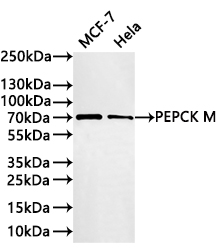
Western Blot
Positive WB detected in: MCF-7 whole cell lysate(30µg), Hela whole cell lysate(30µg)
All lanes: PEPCK M antibody at 1:1000
Secondary
Goat polyclonal to rabbit IgG at 1/40000 dilution
Predicted band size: 71 kDa
Observed band size: 71 kDa
Exposure time:2min
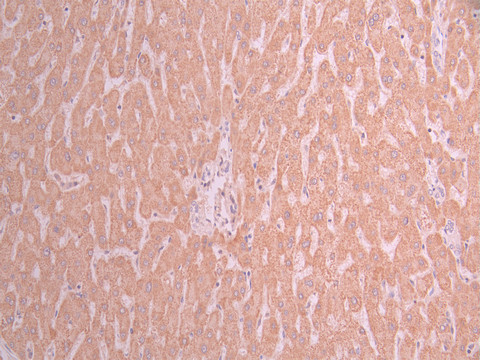
IHC image of CSB-RA900837A0HU diluted at 1:100 and staining in paraffin-embedded human liver cancer performed on a Leica BondTM system. After dewaxing and hydration, antigen retrieval was mediated by high pressure in a citrate buffer (pH 6.0). Section was blocked with 10% normal goat serum 30min at RT. Then primary antibody (1% BSA) was incubated at 4°C overnight. The primary is detected by a Goat anti-rabbit polymer IgG labeled by HRP and visualized using 0.05% DAB.
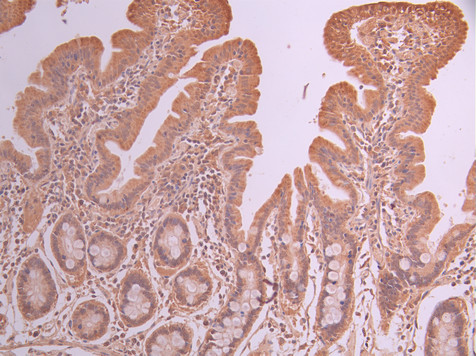
IHC image of CSB-RA900837A0HU diluted at 1:100 and staining in paraffin-embedded human small intestine tissue performed on a Leica BondTM system. After dewaxing and hydration, antigen retrieval was mediated by high pressure in a citrate buffer (pH 6.0). Section was blocked with 10% normal goat serum 30min at RT. Then primary antibody (1% BSA) was incubated at 4°C overnight. The primary is detected by a Goat anti-rabbit polymer IgG labeled by HRP and visualized using 0.05% DAB.
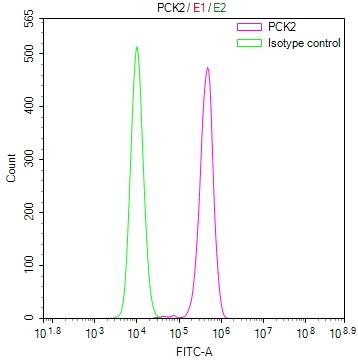
Overlay Peak curve showing Raji cells stained with CSB-RA900837A0HU (red line) at 1:100. The cells were fixed in 4% formaldehyde and permeated by 0.2% TritonX-100 for 10min. Then 10% normal goat serum to block non-specific protein-protein interactions followed by the antibody (1ug/1*106cells) for 45min at 4℃. The secondary antibody used was FITC-conjugated goat anti-rabbit IgG (H+L) at 1/200 dilution for 35min at 4℃.Control antibody (green line) was Rabbit IgG (1ug/1*106cells) used under the same conditions. Acquisition of >10,000 events was performed.
PCK2 Antibody (CSB-PA619092LA01HU)
Validated Data
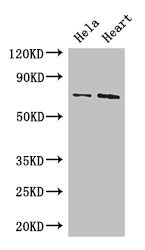
Western Blot
Positive WB detected in: Hela whole cell lysate, Mouse heart tissue
All lanes: PCK2 antibody at 3.4µg/ml
Secondary
Goat polyclonal to rabbit IgG at 1/50000 dilution
Predicted band size: 71, 48, 56 kDa
Observed band size: 71 kDa
The following PCK2 reagents supplied by CUSABIO are manufactured under a strict quality control system. Multiple applications have been validated and solid technical support is offered.
PCK2 Antibodies for Homo sapiens (Human)
| Code | Product Name | Species Reactivity | Application |
|---|---|---|---|
| CSB-PA017614GA01HU | PCK2 Antibody | Human,Mouse,Rat | ELISA,WB,IHC |
| CSB-PA961839 | PCK2 Antibody | Human,Mouse | ELISA,WB,IHC |
| CSB-PA253485 | PCK2 Antibody | Human,Mouse | ELISA,WB,IHC |
| CSB-PA619092LA01HU | PCK2 Antibody | Human, Mouse | ELISA, WB |
| CSB-PA619092LB01HU | PCK2 Antibody, HRP conjugated | Human | ELISA |
| CSB-PA619092LC01HU | PCK2 Antibody, FITC conjugated | Human | |
| CSB-PA619092LD01HU | PCK2 Antibody, Biotin conjugated | Human | ELISA |
| CSB-RA900837A0HU | PCK2 Recombinant Monoclonal Antibody | Human | ELISA, WB, IHC, FC |
PCK2 Antibodies for Schizosaccharomyces pombe (strain 972 / ATCC 24843) (Fission yeast)
| Code | Product Name | Species Reactivity | Application |
|---|---|---|---|
| CSB-PA336190XA01SXV | pck2 Antibody | Schizosaccharomyces pombe (strain 972 / ATCC 24843) (Fission yeast) | ELISA, WB (ensure identification of antigen) |
PCK2 Proteins for Gallus gallus (Chicken)
| Code | Product Name | Source |
|---|---|---|
| CSB-YP017614CH CSB-EP017614CH CSB-BP017614CH CSB-MP017614CH CSB-EP017614CH-B |
Recombinant Chicken Phosphoenolpyruvate carboxykinase [GTP], mitochondrial (PCK2), partial | Yeast E.coli Baculovirus Mammalian cell In Vivo Biotinylation in E.coli |
PCK2 Proteins for Schizosaccharomyces pombe (strain 972 / ATCC 24843) (Fission yeast)
| Code | Product Name | Source |
|---|---|---|
| CSB-YP336190SXV CSB-EP336190SXV CSB-BP336190SXV CSB-MP336190SXV CSB-EP336190SXV-B |
Recombinant Schizosaccharomyces pombe Protein kinase C-like 2 (pck2), partial | Yeast E.coli Baculovirus Mammalian cell In Vivo Biotinylation in E.coli |
PCK2 Proteins for Homo sapiens (Human)
| Code | Product Name | Source |
|---|---|---|
| CSB-YP619092HU CSB-BP619092HU CSB-MP619092HU CSB-EP619092HU-B |
Recombinant Human Phosphoenolpyruvate carboxykinase [GTP], mitochondrial (PCK2) | Yeast Baculovirus Mammalian cell In Vivo Biotinylation in E.coli |
| CSB-EP619092HU | Recombinant Human Phosphoenolpyruvate carboxykinase [GTP], mitochondrial (PCK2) | E.coli |
PCK2 Proteins for Dictyostelium discoideum (Slime mold)
| Code | Product Name | Source |
|---|---|---|
| CSB-YP769710DKK CSB-EP769710DKK CSB-BP769710DKK CSB-MP769710DKK CSB-EP769710DKK-B |
Recombinant Dictyostelium discoideum Phosphoenolpyruvate carboxykinase [GTP], mitochondrial (pck2), partial | Yeast E.coli Baculovirus Mammalian cell In Vivo Biotinylation in E.coli |
PCK2 Proteins for Mus musculus (Mouse)
| Code | Product Name | Source |
|---|---|---|
| CSB-YP806366MO CSB-EP806366MO CSB-BP806366MO CSB-MP806366MO CSB-EP806366MO-B |
Recombinant Mouse Phosphoenolpyruvate carboxykinase [GTP], mitochondrial (Pck2) | Yeast E.coli Baculovirus Mammalian cell In Vivo Biotinylation in E.coli |
PCK2 Proteins for Urochloa panicoides (Panic liverseed grass)
| Code | Product Name | Source |
|---|---|---|
| CSB-YP895891UAU CSB-EP895891UAU CSB-BP895891UAU CSB-MP895891UAU CSB-EP895891UAU-B |
Recombinant Urochloa panicoides Phosphoenolpyruvate carboxykinase [ATP] 2 (PCK2), partial | Yeast E.coli Baculovirus Mammalian cell In Vivo Biotinylation in E.coli |