
Call us
301-363-4651 (Available 9 a.m. to 5 p.m. CST from Monday to Friday)

| Code | CSB-RA019284A621phHU |
| Size | US$210 |
| Order now | |
| Image |
|
| Have Questions? | Leave a Message or Start an on-line Chat |
| Application | Recommended Dilution |
|---|---|
| WB | 1:500-1:5000 |
| IF | 1:20-1:200 |
RAF1 phosphorylation at serine 621 represents a critical regulatory mechanism in the MAPK/ERK signaling cascade, influencing cell proliferation, differentiation, and survival decisions. This phosphorylation site serves as a key indicator of RAF1 activation status, making its detection essential for researchers investigating oncogenic signaling, growth factor responses, and therapeutic targeting of the RAS-RAF-MEK-ERK pathway.
This recombinant monoclonal antibody, generated against a synthetic phosphopeptide corresponding to human Phospho-RAF1 at S621, offers the reproducibility and consistency that phospho-specific detection demands. Because recombinant production ensures a sequence-defined, clonally derived reagent, researchers can expect reliable lot-to-lot performance across extended studies—particularly valuable when tracking subtle changes in phosphorylation dynamics over time or across treatment conditions.
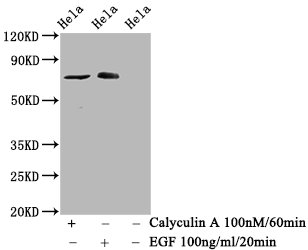
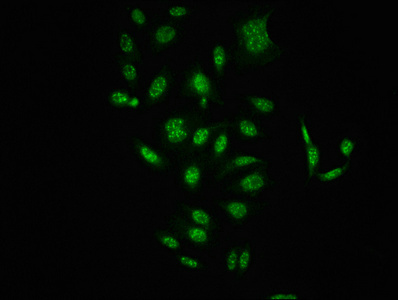
Validation studies demonstrate robust performance in Western blot applications, where the antibody detects a band at the expected 73 kDa molecular weight in HeLa whole cell lysates following stimulation with either Calyculin A or EGF. This confirmation across different activation stimuli supports the antibody's utility for investigating both phosphatase inhibition and growth factor-mediated signaling contexts. For immunofluorescence applications, testing in HepG2 cells treated with Calyculin A reveals clear subcellular localization patterns, enabling spatial analysis of RAF1 phosphorylation within intact cells.
The antibody's compatibility with both biochemical and imaging approaches provides flexibility for researchers examining RAF1 activation through complementary methods. Whether characterizing upstream pathway activation, validating kinase inhibitor efficacy, or mapping phosphorylation dynamics in cancer models, this reagent supports signal transduction research where phospho-specific detection fidelity is paramount.
There are currently no reviews for this product.





