
Call us
301-363-4651 (Available 9 a.m. to 5 p.m. CST from Monday to Friday)

| Code | CSB-RA019284A43phHU |
| Size | US$210 |
| Order now | |
| Image |
|
| Have Questions? | Leave a Message or Start an on-line Chat |
| Application | Recommended Dilution |
|---|---|
| IF | 1:20-1:200 |
RAF1, also known as c-RAF, serves as a critical serine/threonine kinase within the MAPK/ERK signaling cascade, functioning as a key intermediary between RAS activation and downstream MEK phosphorylation. Phosphorylation at serine 43 represents an important regulatory modification that influences RAF1 activity and its interactions within signaling complexes, making this site particularly relevant for researchers investigating signal transduction dynamics, cell proliferation, and oncogenic pathway regulation.
This recombinant monoclonal antibody, developed using clone 1F7 in rabbit host, specifically recognizes the phosphorylated serine 43 residue of human RAF1. The recombinant production method ensures exceptional lot-to-lot consistency and sequence-defined specificity, providing researchers with reliable, reproducible results across extended studies. Unlike traditional hybridoma-derived antibodies, this recombinant format eliminates the variability that can complicate longitudinal experiments or multi-site collaborations.
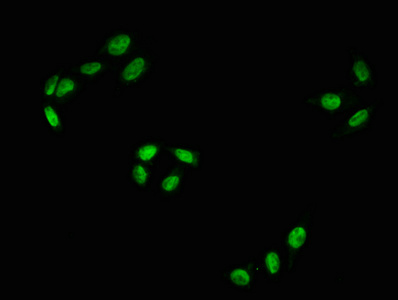
Validation through immunofluorescence microscopy demonstrates clear detection of phospho-RAF1 (S43) in HeLa cells, with recommended working dilutions ranging from 1:20 to 1:200 depending on experimental conditions. The validation protocol employed standard fixation with 4% formaldehyde and permeabilization using 0.2% Triton X-100, confirming compatibility with common immunofluorescence workflows. The antibody is also validated for ELISA applications, offering flexibility for researchers requiring both imaging-based and quantitative detection approaches.
Supplied in a stabilized liquid format containing glycerol for optimal long-term storage at -20°C or -80°C, this antibody is well-suited for signal transduction research, particularly studies examining RAF1 regulation, MAPK pathway activation, and phosphorylation-dependent signaling events in human cell models.
There are currently no reviews for this product.





