
Call us
301-363-4651 (Available 9 a.m. to 5 p.m. CST from Monday to Friday)

| Code | CSB-RA977797A0HU |
| Size | US$210 |
| Order now | |
| Image |
|
| Have Questions? | Leave a Message or Start an on-line Chat |
| Application | Recommended Dilution |
|---|---|
| WB | 1:500-1:5000 |
| IHC | 1:50-1:200 |
CD274, widely recognized as PD-L1, serves as a critical immune checkpoint molecule that has transformed our understanding of tumor immune evasion. By engaging PD-1 on T cells, PD-L1 suppresses anti-tumor immunity, making it a central focus in cancer immunology research and a validated therapeutic target across multiple malignancies.
This recombinant monoclonal antibody, clone 10D4, offers the reproducibility that rigorous PD-L1 research demands. Generated against a synthetic peptide derived from human PD-L1, the antibody is produced using recombinant technology, ensuring sequence-defined consistency between lots. This eliminates the variability inherent in traditional hybridoma-derived antibodies, allowing you to confidently compare results across extended studies and collaborative projects.
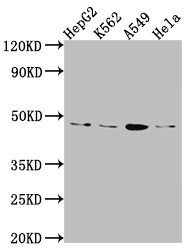
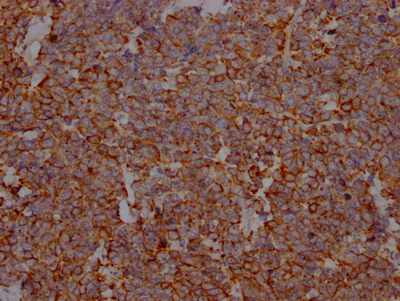
Validation across multiple platforms demonstrates this antibody's versatility in your experimental workflows. Western blot analysis at 1:1000 dilution successfully detects PD-L1 in HepG2, K562, A549, and Hela cell lysates, with an observed band at approximately 45 kDa. While the predicted molecular weight is 34 kDa, the higher observed size reflects the extensive glycosylation characteristic of PD-L1, a post-translational modification known to influence its stability and immunosuppressive function. For tissue-based studies, immunohistochemistry validation in paraffin-embedded human lung cancer tissue at 1:100 dilution reveals clear staining using standard citrate buffer antigen retrieval, providing a reliable protocol for tumor microenvironment investigations.
Whether you are characterizing PD-L1 expression in cancer cell lines, examining checkpoint molecule distribution in tumor specimens, or investigating immune regulation mechanisms, this antibody delivers the consistency and validated performance essential for advancing immunology and oncology research.
There are currently no reviews for this product.





