
Call us
301-363-4651 (Available 9 a.m. to 5 p.m. CST from Monday to Friday)

| Code | CSB-RA024077A09phHU |
| Size | US$210 |
| Order now | |
| Image |
|
| Have Questions? | Leave a Message or Start an on-line Chat |
| Application | Recommended Dilution |
|---|---|
| IF | 1:20-1:200 |
Phosphorylation of tumor suppressor p53 at serine 9 represents a critical regulatory modification that influences p53 stability and transcriptional activity in response to cellular stress. As a master regulator of cell cycle arrest, DNA repair, and apoptosis, p53 undergoes complex post-translational modifications that fine-tune its tumor suppressor functions. Detecting site-specific phosphorylation events like Ser9 provides researchers with essential insights into p53 activation dynamics and stress response pathways.
This recombinant monoclonal antibody, generated against a synthetic phosphopeptide corresponding to human Phospho-TP53 at serine 9, offers the reproducibility and consistency that phospho-specific detection demands. Produced using recombinant technology with a defined sequence, this rabbit IgG antibody eliminates the lot-to-lot variability that can compromise longitudinal studies of signaling events. The affinity-purified preparation ensures minimal background while maintaining strong specificity for the phosphorylated epitope.
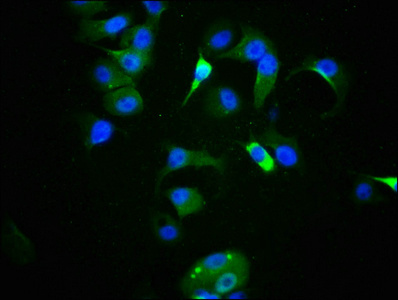
Validation through immunofluorescence microscopy demonstrates clear nuclear localization in MCF-7 human breast cancer cells, a well-established model for p53 research. Using standard fixation with formaldehyde and permeabilization with Triton X-100, the antibody produces robust staining at dilutions ranging from 1:20 to 1:200, offering flexibility to optimize signal intensity for different experimental conditions and imaging systems.
For researchers investigating p53 signaling in cancer biology, DNA damage responses, or cell cycle regulation, this antibody provides a reliable tool for visualizing phospho-p53 dynamics at the single-cell level. The validated immunofluorescence protocol enables spatial analysis of p53 activation within heterogeneous cell populations, supporting studies of stress-induced signaling and therapeutic responses in human cancer models.
There are currently no reviews for this product.





