
Call us
301-363-4651 (Available 9 a.m. to 5 p.m. CST from Monday to Friday)


Norovirus (NoV) is a non-enveloped, single-stranded positive-sense RNA virus and one of the leading pathogens of acute gastroenteritis worldwide. It causes approximately 685 million infections annually, making it the primary cause of non-bacterial gastroenteritis outbreaks and a significant contributor to sporadic gastroenteritis in both children and adults. The virus is primarily transmitted via the fecal-oral route, including through contaminated food (such as lettuce and seaweed), water, or person-to-person contact.
Norovirus belongs to the family Caliciviridae, a small, non-enveloped RNA virus with a diameter of approximately 26–34 nm. The viral particles exhibit a typical cup-shaped structure, with a capsid featuring T=3 icosahedral symmetry, assembled from 180 identical VP1 proteins.
The structure of a virus primarily consists of:
VP1: Major Capsid Protein;
VP2: Minor Capsid Protein;
Non-structural proteins (NS1/2–NS7): Involved in viral replication and assembly.
The VP1 protein can be further divided into two main structural domains:
Capsid domain: Forms the inner, tightly packed spherical framework of the capsid, which encloses and protects the viral genome.
Protruding domain: Located outside the shell domain, it forms an outward-extending arched protrusion and is a key region for virus-host cell interactions. The protruding domain can be further subdivided into two subdomains, P1 and P2, with the P2 subdomain situated at the outermost part. It serves as the primary site determining viral antigen diversity, recognizing host tissue blood group antigens, and binding neutralizing antibodies [1].
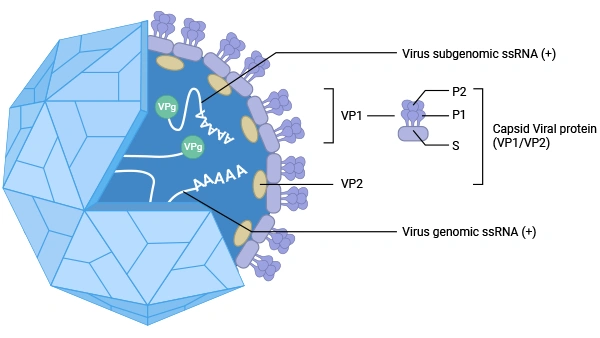
Figure 1. The Norovirus (NoV) virion
Based on sequence similarity analysis of VP1 and NS7 polymerase, noroviruses can be classified into ten distinct genogroups (GI–GX), which can be further subdivided into 49 genotypes. Among these, only the GI, GII, and GIV genogroups cause acute gastroenteritis in humans. The GII. 4 genotype is associated with severe clinical courses and has given rise to six pandemic strains, while GII. 17 is another genotype recently detected with high transmissibility.
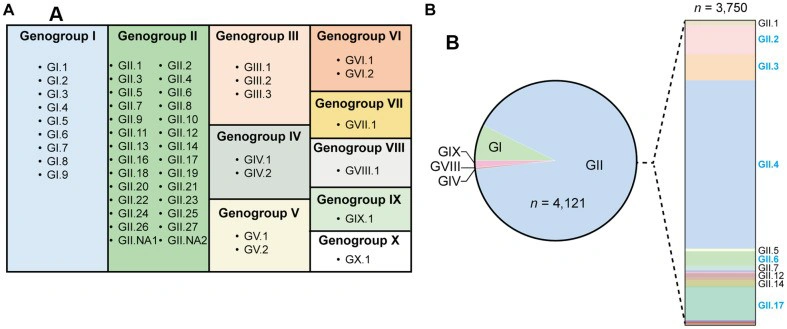
Figure 2. Schematic overview of norovirus classification showing the ten recognized genogroups (GI–GX) and their respective genotypes.
Image from: PMID: 41218799
| Target | Product Name | Source | Tag Info | Product Code |
|---|---|---|---|---|
| ORF2 | Recombinant Norovirus Capsid protein VP1 (ORF2) | Mammalian cell | C-terminal Flag-Myc-tagged | CSB-MP767779NBAY |
| ORF2 | Recombinant Norovirus Capsid protein VP1 (ORF2) | Yeast | N-terminal 6xHis-tagged | CSB-YP767779NBAY |
| ORF2 | Recombinant Norovirus Capsid protein VP1 (ORF2) | E.coli | N-terminal 10xHis-tagged | CSB-EP767779NBAYb0 |
| N/A | Recombinant Norovirus Hu/GII.4/Sydney/NSW0514/2012/AU VP1, partial | E.coli | C-terminal 6xHis-tagged | CSB-EP6933IOA |
The pathogenesis of norovirus is multifactorial.The outcomes of collaboration can be primarily categorized into the following levels:
2.1 Viral level: NS1 inhibits interferon, NS3 induces cell lysis, and capsid mutations enhance virulence.
2.2 Host level: HBGA/FUT2 genetic background, immune deficiency status, age-related susceptibility (e. g., passive absorption in young hosts).

Figure 3. Presumed pathogenesis of CVID‐associated enteropathy complicated by chronic norovirus infection.
Image from:PMID: 41229388
2.3 Environmental aspects: microbial regulation, aerosol transmission, and shellfish enrichment.
Norovirus is one of the primary pathogens of acute gastroenteritis worldwide, with an extremely high transmission capacity, capable of triggering large-scale outbreaks in various environments. Understanding its complex transmission pathways is crucial for developing effective prevention and control strategies.
Main transmission routes
Contact transmission is the most basic and common way for norovirus to spread between people, primarily including direct and indirect contact.
Direct contact: Having close contact with symptomatic or asymptomatic infected individuals.
Indirect contact: Contact with virus-contaminated surfaces (such as door handles, tabletops, toys, etc.), followed by infection through the hand-to-mouth route.
Consuming food or water contaminated with norovirus is the primary cause of large-scale outbreaks.
Sources of Pollution: Viruses can be introduced into the food chain by infected food handlers during food preparation or through contaminated irrigation water, shellfish, and other sources.
Drinking or coming into contact with water sources contaminated with feces (such as well water or recreational water) can lead to norovirus outbreaks. Additionally, the virus may persist throughout the entire process of sewage collection, treatment, and discharge, causing ongoing contamination of the environment and water sources through various pathways.
When patients vomit or have diarrhea, they can produce aerosols containing viral particles. Studies using feline calicivirus (FCV) as a surrogate for norovirus have confirmed the possibility of aerosol transmission and the effectiveness of corresponding air purification technologies.
Molecular Biology Testing: Real-time fluorescent quantitative PCR technology, with its high sensitivity and specificity, is the gold standard for clinical diagnosis of norovirus. By continuously optimizing detection methods and primer design, the accuracy and efficiency of detection can be improved.
Immunological Testing: Such as enzyme-linked immunosorbent assay (ELISA) and colloidal gold immunochromatography, which are simple to operate and suitable for batch screening. By developing antibodies with high sensitivity and specificity, the accuracy and reliability of immunological detection can be improved.
New Detection Technologies: For instance, metagenomic sequencing technology enables the direct detection of norovirus in clinical samples without the need for culturing, providing robust support for epidemic surveillance and source tracing.
Q:Why do some people not get infected even after exposure to norovirus?
This is related to an individual's genetic background, particularly the functional status of the FUT2 gene. The FUT2 gene encodes α(1, 2) fucosyltransferase, which is responsible for synthesizing histo-blood group antigens (HBGAs) on the surface of intestinal cells. HBGAs serve as key receptors for norovirus recognition and infection of host cells. If an individual carries an inactivating mutation in the FUT2 gene (i. e., a "non-secretor" individual), they are unable to express HBGAs on the surface of intestinal epithelial cells. As a result, the virus cannot effectively bind to and invade these cells, granting these individuals natural resistance to certain norovirus strains, such as Norwalk virus.
Q:Why can norovirus survive for so long in the environment?
Due to its lack of an envelope structure and its strong environmental tolerance. Norovirus lacks a lipid envelope, making it highly resistant to environmental factors such as dryness, acids, alkalis, and temperature. It can survive for 3 hours in an acidic environment with a pH of 2.7, remain infectious after heating at 60°C for 30 minutes, persist in frozen foods for up to 6 months, and survive on contaminated surfaces for more than 7 days. This stability makes it easily transmissible through food, water, and contact, and extremely difficult to eradicate completely.
Q:Why does diarrhea occur after norovirus infection?
Diarrhea is a direct result of viruses interfering with the absorption of water in the intestines. The VP1 capsid protein of norovirus can activate PKD2 through the TLR2/MyD88/IRAK4 signaling pathway, thereby inhibiting the nuclear translocation of the transcription factor AP2γ, leading to downregulation of aquaporin AQP3 expression in intestinal epithelial cells. AQP3 is responsible for water reabsorption, and its reduced expression decreases the intestinal water absorption capacity, ultimately causing water retention in the intestinal lumen and triggering diarrhea.
Q:Why Does Norovirus Repeatedly Infect the Same Person?
Because the virus has multiple genotypes and the immune protection period is short. Norovirus can be classified into multiple genogroups such as GI, GII, and GIV, each of which includes various genotypes (e. g., GII. 4, GII. 17, etc.). There are significant antigenic differences among different genotypes, meaning that antibodies produced after infection with one genotype may be ineffective against another. Additionally, the immune protection period for norovirus typically lasts only 6 months to 2 years, allowing individuals to experience multiple infections throughout their lifetime.
[1] Winder N, Gohar S, Muthana M. Norovirus: An Overview of Virology and Preventative Measures. Viruses 2022; 14(12): 2811. doi:10.3390/v14122811
[2] Kennedy EA, et al. Age-associated features of norovirus infection analysed in mice. Nature Microbiol 2023; 8: 1023–1032. doi:10.1038/s41564-023-01383-1
[3] Lindesmith L, et al. Human susceptibility and resistance to Norwalk virus infection. Nature Med 2003; 9: 548–553. doi:10.1038/nm860
[4] Prasad BV, et al. Norovirus replication, host interactions and vaccine advances. Nat Rev Microbiol 2025; 23: 456–472. doi:10.1038/s41579-024-01144-9
Proteins
Antibodies
ELISA Kits


