
Call us
301-363-4651 (Available 9 a.m. to 5 p.m. CST from Monday to Friday)

| Code | CSB-RA015270A62phHU |
| Size | US$210 |
| Order now | |
| Image |
|
| Have Questions? | Leave a Message or Start an on-line Chat |
| Application | Recommended Dilution |
|---|---|
| WB | 1:500-1:5000 |
| IF | 1:20-1:200 |
MYC stands as one of the most extensively studied oncogenes in cancer biology, functioning as a master transcriptional regulator that controls cell proliferation, growth, and apoptosis. Phosphorylation at serine 62 represents a critical regulatory modification that stabilizes MYC protein and enhances its transcriptional activity, making this specific phospho-epitope a valuable marker for studying MYC activation states in oncogenic signaling pathways.
This recombinant monoclonal antibody, clone 2A10, offers researchers the consistency and reliability that comes with sequence-defined production. Unlike traditional hybridoma-derived antibodies, recombinant technology ensures that every lot performs identically, eliminating the variability that can compromise longitudinal studies or multi-site collaborations. The rabbit IgG format provides excellent signal-to-noise characteristics, while affinity chromatography purification delivers a reagent ready for demanding applications.
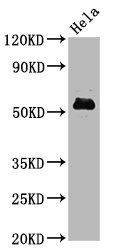
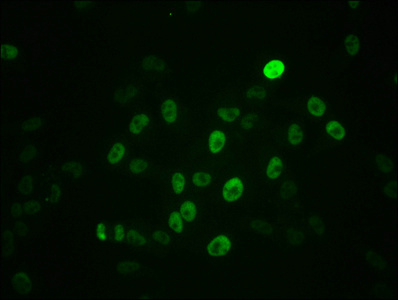
Validation studies demonstrate robust performance across multiple experimental platforms. In western blot analysis of HeLa whole cell lysates, the antibody detects a band at the predicted molecular weight of 57 kDa, confirming specific recognition of phosphorylated MYC. The recommended working dilution range of 1:500 to 1:5000 provides flexibility for optimization across different sample types and detection systems. Immunofluorescence studies in HeLa cells reveal clear nuclear localization patterns consistent with MYC's role as a transcription factor, with effective staining achieved at dilutions between 1:20 and 1:200.
This antibody serves researchers investigating epigenetics and nuclear signaling, particularly those exploring MYC-driven transcriptional programs, cell cycle regulation, and oncogenic transformation. Its validated performance in both biochemical and imaging applications makes it a versatile tool for dissecting the phospho-regulatory mechanisms that govern MYC function in normal physiology and disease states.
There are currently no reviews for this product.





