IGHE Recombinant Monoclonal Antibody

Code CSB-RA16849MA1HU
Size US$210
Order now
Image
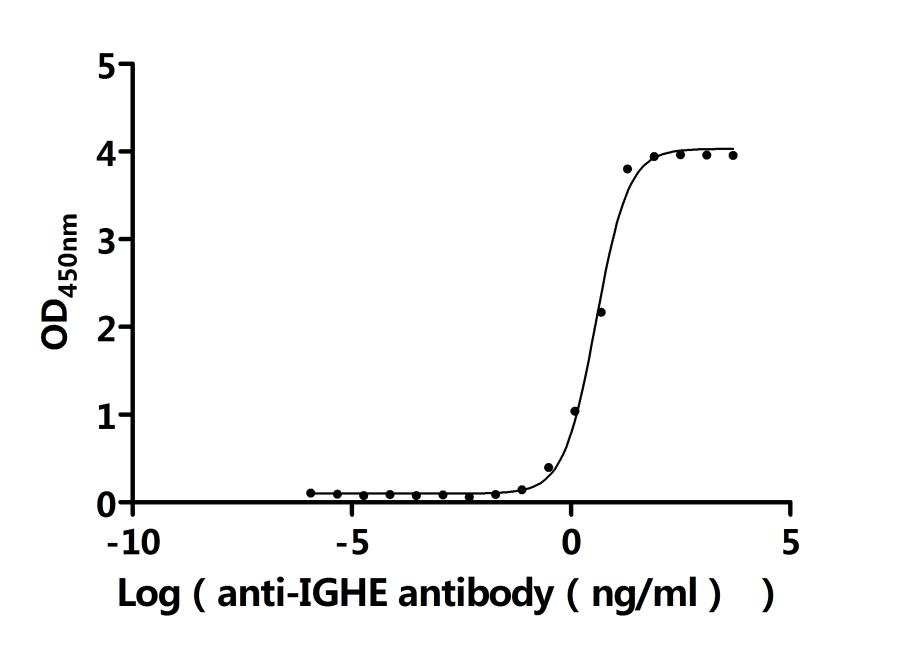
  • The Binding Activity of Human IGHE with Anti-IGHE Recombinant Antibody
    Activity: Measured by its binding ability in a functional ELISA. Immobilized Human IGHE (CSB-MP1684HU3d7) at 2 μg/mL can bind Anti-IGHE recombinant antibody. The EC50 is 3.097-4.487 ng/mL.
Have Questions? Leave a Message or Start an on-line Chat

Product Details

Uniprot No.
Target Names
Alternative Names
Immunoglobulin heavy constant epsilon (Ig epsilon chain C region) (Ig epsilon chain C region ND) , IGHE
Species Reactivity
Human
Immunogen
Recombinant Human IGHE protein
Immunogen Species
Homo sapiens (Human)
Conjugate
Non-conjugated
Clonality
Monoclonal
Isotype
hIgG1
Clone No.
11D7
Purification Method
Affinity-chromatography
Concentration
It differs from different batches. Please contact us to confirm it.
Buffer
Preservative: 0.03% Proclin 300
Constituents: 50% Glycerol, 0.01M PBS, PH 7.4
Form
Liquid
Tested Applications
ELISA
Recommended Dilution
Application Recommended Dilution
ELISA 1:5000-1:50000
Protocols
Troubleshooting and FAQs
Storage
Upon receipt, store at -20°C or -80°C. Avoid repeated freeze.
Lead Time
Basically, we can dispatch the products out in 1-3 working days after receiving your orders. Delivery time maybe differs from different purchasing way or location, please kindly consult your local distributors for specific delivery time.
Description

Immunoglobulin heavy constant epsilon (IGHE) forms the constant region of IgE antibodies, the least abundant immunoglobulin class in circulation yet one of the most biologically potent. IgE plays a central role in type I hypersensitivity reactions, allergic responses, and defense against parasitic infections. The epsilon heavy chain determines IgE's unique ability to bind high-affinity FcεRI receptors on mast cells and basophils, triggering degranulation upon allergen crosslinking. This makes IGHE a critical target for researchers investigating allergic disease mechanisms, asthma pathophysiology, and novel therapeutic approaches targeting the IgE pathway.

This recombinant monoclonal antibody, clone 11D7, offers the reproducibility essential for longitudinal studies and multi-site collaborations. Because recombinant antibodies are produced from defined sequences rather than hybridoma supernatants, you can expect consistent performance across lots, eliminating the variability that can compromise experimental comparisons over time. The antibody is supplied in human IgG1 format and has been affinity-purified to ensure high specificity for human IGHE.

Functional ELISA validation demonstrates robust binding activity, with immobilized human IGHE protein detected at EC50 values ranging from 3.097 to 4.487 ng/mL, indicating excellent sensitivity at recommended dilutions between 1:5000 and 1:50000. This broad working range provides flexibility for optimizing signal-to-noise ratios across different experimental setups.

This antibody supports research into IgE-mediated allergic disorders, anti-IgE therapeutic development, and fundamental studies of humoral immunity. Its validated performance in ELISA makes it particularly suited for quantitative detection of IGHE in serum samples or recombinant protein characterization studies.

Usage
For Research Use Only. Not for use in diagnostic or therapeutic procedures.

Customer Reviews and Q&A

 Customer Reviews

There are currently no reviews for this product.

Submit a Review here

Target Background

Function
Constant region of immunoglobulin heavy chains. Immunoglobulins, also known as antibodies, are membrane-bound or secreted glycoproteins produced by B lymphocytes. In the recognition phase of humoral immunity, the membrane-bound immunoglobulins serve as receptors which, upon binding of a specific antigen, trigger the clonal expansion and differentiation of B lymphocytes into immunoglobulins-secreting plasma cells. Secreted immunoglobulins mediate the effector phase of humoral immunity, which results in the elimination of bound antigens. The antigen binding site is formed by the variable domain of one heavy chain, together with that of its associated light chain. Thus, each immunoglobulin has two antigen binding sites with remarkable affinity for a particular antigen. The variable domains are assembled by a process called V-(D)-J rearrangement and can then be subjected to somatic hypermutations which, after exposure to antigen and selection, allow affinity maturation for a particular antigen.
Subcellular Location
Secreted. Cell membrane.
Database Links

HGNC: 5522

OMIM: 147180

icon of phone
Call us
301-363-4651 (Available 9 a.m. to 5 p.m. CST from Monday to Friday)

icon of address
Address
No. 269, Shendun 5th Road, Donghu Hi-Tech Development Area, Hubei Province, 430206, P.R.China
icon of social media
Join us with

Subscribe newsletter

Leave a message

* To protect against spam, please pass the CAPTCHA test below.
CAPTCHA verification
© 2007-2026 CUSABIO TECHNOLOGY LLC All rights reserved. 鄂ICP备15011166号-1
Place an order now

I. Product details

*
*
*
*

II. Contact details

*
*

III. Ship To

*
*
*
*
*
*
*

IV. Bill To

*
*
*
*
*
*
*
*


