
Call us
301-363-4651 (Available 9 a.m. to 5 p.m. CST from Monday to Friday)

| Code | CSB-EP328425DSA |
| Abbreviation | Recombinant Chlamydia trachomatis ompA protein |
| MSDS | |
| Size | US$388 |
| Order now | |
| Image |
|
| Have Questions? | Leave a Message or Start an on-line Chat |
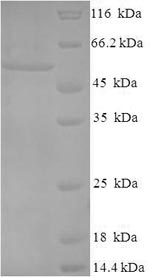
This recombinant Chlamydia trachomatis Major outer membrane porin (ompA), serovar A, is expressed in E. coli and contains the full length of the mature protein (23-396aa). It comes with an N-terminal 6xHis-SUMO tag that helps with purification and detection. SDS-PAGE analysis confirms the product shows purity levels above 90%, which appears to provide reliable performance for research applications.
The Major outer membrane porin of Chlamydia trachomatis, often called ompA, seems to play an important role in bacterial outer membrane structure. This protein is involved in maintaining membrane integrity and permeability, and it also functions in immune responses during infection. Given its significance in cellular interactions and potential as a vaccine target, ompA has become a key focus in microbial pathogenesis research.
Potential Applications
Note: The applications listed below are based on what we know about this protein's biological functions, published research, and experience from experts in the field. However, we haven't fully tested all of these applications ourselves yet. We'd recommend running some preliminary tests first to make sure they work for your specific research goals.
Chlamydia trachomatis major outer membrane porin (ompA) is a transmembrane protein that requires precise folding, proper membrane integration, and specific trimerization for its functional porin activity. The E. coli expression system is homologous to this bacterial porin, which increases the probability of correct folding and trimerization. However, the large N-terminal 6xHis-SUMO tag (∼15 kDa) may sterically interfere with the protein's membrane insertion domains and trimerization interfaces. While the full-length mature protein (23-396aa) contains all functional domains, the probability of correct folding with functional porin activity requires experimental validation of membrane integration and pore formation.
1. Antibody Development and Characterization Studies
This application is highly suitable as antibody development relies on antigenic sequence recognition rather than functional membrane integration. The full-length mature protein provides comprehensive epitope coverage for generating ompA-specific antibodies. The high purity (>90%) ensures minimal contamination-related issues during immunization protocols.
2. Protein-Protein Interaction Studies
This application carries a significant risk without proper folding and trimerization validation. ompA interactions with host proteins require precise tertiary structure and proper trimer formation. If correctly folded and trimerized (verified), the protein may identify physiological interaction partners. If misfolded/unverified, there is a high risk of non-specific binding or failure to replicate genuine host-pathogen interactions. The SUMO tag may create artificial interaction surfaces.
3. Structural and Biochemical Characterization
These studies are essential for determining folding status. Techniques should include circular dichroism spectroscopy to assess secondary structure, size-exclusion chromatography to evaluate trimeric state, and thermal shift assays to determine stability. However, the SUMO tag may interfere with crystallization for high-resolution structural studies of the native porin.
4. Serovar-Specific Research Applications
Meaningful comparative studies require native protein conformation and trimerization. If correctly folded and trimerized (verified), the protein enables valid serovar comparisons. If misfolded/unverified, comparative analyses would yield misleading insights about serovar-specific differences.
Final Recommendation & Action Plan
The E. coli expression system is favorable for producing bacterial ompA, but the large SUMO tag may interfere with proper trimerization and membrane integration. Begin with Application 3 (Structural Characterization) to assess folding quality through CD spectroscopy, SEC (trimer analysis), and validate porin activity using liposome swelling assays or channel conductance measurements. Applications 2 and 5 require rigorous structural and functional validation before proceeding. Application 1 (antibody development) can proceed immediately. For reliable ompA research requiring native functionality, consider tag removal and membrane reconstitution studies to preserve trimeric structure and porin activity.
There are currently no reviews for this product.





