
Call us
301-363-4651 (Available 9 a.m. to 5 p.m. CST from Monday to Friday)

| Code | CSB-RA618770A1981phHU |
| Size | US$210 |
| Order now | |
| Image |
|
| Have Questions? | Leave a Message or Start an on-line Chat |
| Application | Recommended Dilution |
|---|---|
| IF | 1:20-1:200 |
ATM kinase stands as a central orchestrator of the cellular response to DNA double-strand breaks, one of the most dangerous forms of genomic damage. Upon detecting these lesions, ATM undergoes rapid autophosphorylation at serine 1981, a critical activation event that transforms the kinase from inactive dimers into active monomers capable of phosphorylating downstream effectors including p53, CHK2, and H2AX. This phosphorylation event serves as a reliable molecular marker for monitoring DNA damage response activation, making it invaluable for studies investigating genomic instability, checkpoint signaling, and the cellular mechanisms underlying ataxia-telangiectasia syndrome.
This recombinant monoclonal antibody, generated against a synthetic phosphopeptide encompassing the human ATM S1981 phosphorylation site, offers the reproducibility essential for longitudinal studies and multi-site collaborations. The sequence-defined nature of recombinant production eliminates the lot-to-lot variability that can complicate phospho-specific detection, where even subtle affinity differences may affect sensitivity to this transient modification.
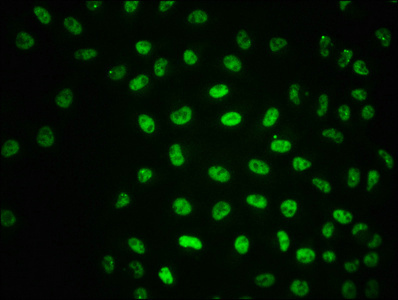
Validation through immunofluorescence microscopy in HeLa cells demonstrates clear nuclear localization patterns consistent with ATM's role in chromatin-associated DNA damage surveillance. The antibody performs effectively at dilutions ranging from 1:20 to 1:200 in immunofluorescence applications, providing flexibility to optimize signal intensity based on your experimental system and detection setup. Additional compatibility with ELISA expands its utility for quantitative assessments of ATM activation status.
Researchers investigating DNA damage signaling pathways, checkpoint mechanisms, or therapeutic responses to genotoxic agents will find this antibody particularly suited for tracking the kinetics and spatial dynamics of ATM activation in human cell models.
There are currently no reviews for this product.





