
Call us
301-363-4651 (Available 9 a.m. to 5 p.m. CST from Monday to Friday)

| Code | CSB-EP389005RIE |
| Abbreviation | Recombinant Rabies virus Glycoprotein, partial |
| MSDS | |
| Size | US$388 |
| Order now | |
| Image |
|
| Have Questions? | Leave a Message or Start an on-line Chat |
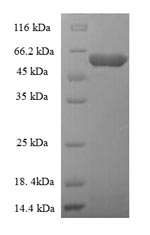
Recombinant Rabies virus Glycoprotein (G) is expressed in E. coli, covering the amino acid region 20-459. The protein carries an N-terminal 6xHis-SUMO tag, which helps with purification and detection. It appears to reach a purity level of over 90%, as confirmed by SDS-PAGE analysis. This product is intended for research use only, potentially providing reliable results for scientific investigations involving the Rabies virus.
Rabies virus Glycoprotein (G) represents a critical component of the viral envelope. It plays a vital role in virus attachment and entry into host cells. The protein seems essential for inducing virus-neutralizing antibodies, which makes it a key target in vaccine research and development. Its involvement in host-pathogen interactions and immune response modulation may underscore its significance in virology studies.
Potential Applications
Note: The applications listed below are based on what we know about this protein's biological functions, published research, and experience from experts in the field. However, we haven't fully tested all of these applications ourselves yet. We'd recommend running some preliminary tests first to make sure they work for your specific research goals.
Rabies virus Glycoprotein (G) is a complex viral envelope protein that requires precise folding, proper disulfide bond formation (with multiple conserved disulfide bonds), glycosylation at specific asparagine residues, and trimerization for its functional activity in receptor binding and viral entry. The E. coli expression system cannot provide the eukaryotic folding environment, oxidative conditions for correct disulfide bond formation, or glycosylation machinery required for this viral glycoprotein. The partial fragment (20-459aa) lacks the complete structural context, and the large N-terminal 6xHis-SUMO tag (∼15 kDa) may sterically interfere with the protein's functional domains. The probability of correct folding with functional receptor-binding activity is extremely low.
1. Antibody Development and Characterization
This application has limited utility. While antibodies can be generated against linear epitopes, they may not recognize conformational epitopes of the native, glycosylated glycoprotein. Antibodies raised against this non-glycosylated, prokaryotically expressed fragment will likely not efficiently bind to the authentic viral glycoprotein in its native conformation.
2. Structural and Biochemical Analysis
Basic biophysical analysis can be performed, but will not reflect native glycoprotein structure. The lack of glycosylation and probable incorrect disulfide bonding mean results will describe an artificial protein rather than the authentic viral glycoprotein. The SUMO tag will dominate structural properties.
Final Recommendation & Action Plan
This E. coli-expressed rabies glycoprotein fragment is unsuitable for functional studies due to the essential requirements for glycosylation and proper disulfide bonding that cannot be met in this expression system. The protein cannot be used for interaction studies and vaccine research. Applications 1 and 2 have severe limitations and should only be used for basic research purposes, with the understanding that results will not reflect native glycoprotein biology. For authentic rabies glycoprotein research, use mammalian-expressed, properly glycosylated full-length protein that preserves native conformational epitopes and receptor-binding capability.
There are currently no reviews for this product.





